

This is a tale about two Wanderers who traveled throughout the world for business and pleasure and collected many items which they liked but not necessarily for the sake of collection.
The tale started when he moved with his family from Marseille, France to Geneva after the war and then on to Montréal, Canada and New Jersey, USA. After university and two years with Uncle Sam, he once met her on a NWA flight from Seattle to Tokyo on which she was a flight attendant.
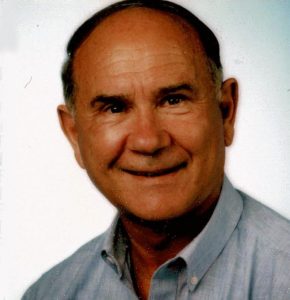
The romance was stretched over Japan, Hong Kong, the Swiss ski slopes, New York, San Francisco, Seattle and long weekends in Porto Rico and Iceland with interludes of short lunches in Paris when the round trip could be made in a weekend. There were also working trips with he, in first class drinking champagne and she providing the onboard service.
All this culminated with a ceremony at the Stockton City Hall, California.
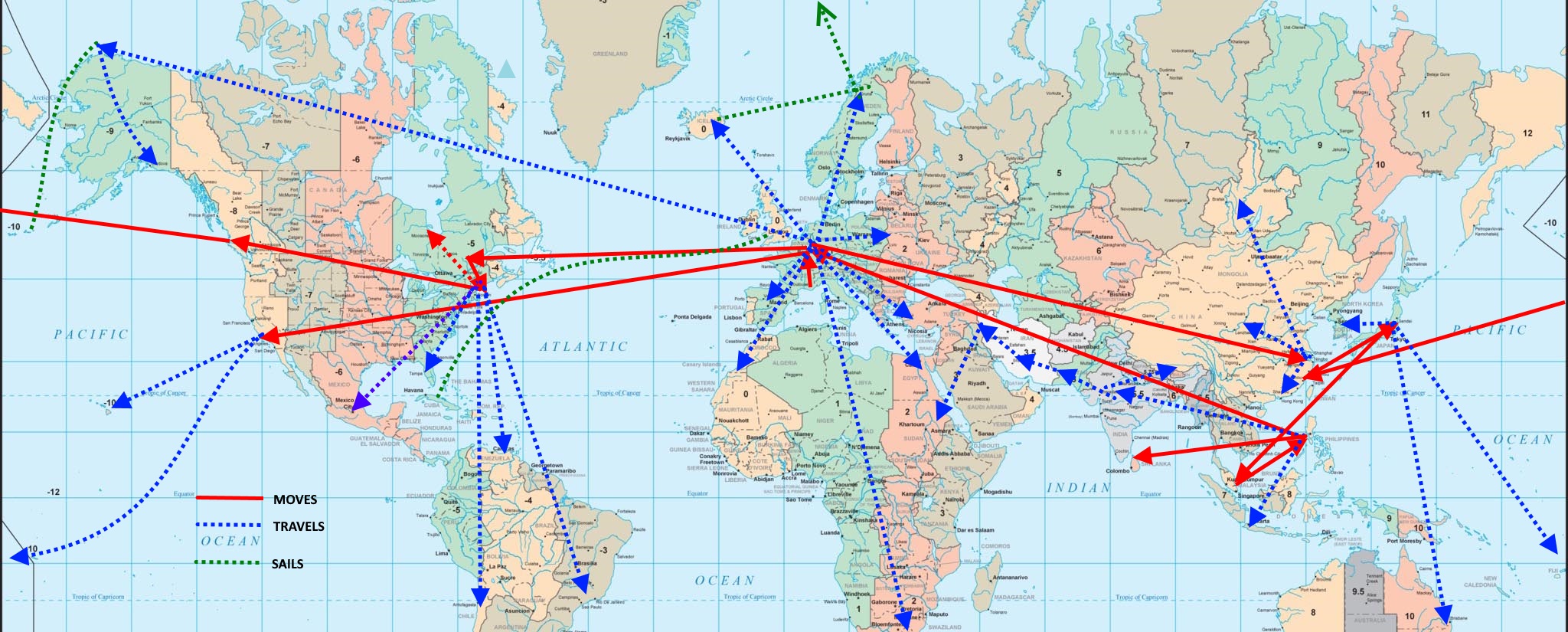
Then he went back to New York and she to Seattle. However, a few months later, they were asked to move to Hong Kong which was to be followed in the next 50 years with moves to Tokyo, Kyoto, Singapore, Manila, Paris, Montreux, Monaco, Shanghai and Los Angeles.
Repulse Bay Hotel
In 1969, Hong Kong was still a British colony with half the population that it has now. Antique pieces were still to be found at ladder Street and many small shops in the Central district. Much came from China and Ming pieces, and Celadon were found relatively low prices – we should have bought more!!
They lived in the Repulse Bay hotel – an antique in its own right. Since his business area covered from Pakistan (West Pakistan at time) to Japan, they spent alternatively one month going West to Vietnam, Thailand, Burma, Ceylan and India – and one trip East to Taiwan, Korea and Japan. In between was a recess in Hong Kong.
The Vietnam conflict was still on and the main tourists were soldiers on RR and then mostly in Thailand, Taiwan and Australia.
The Wanderers travelled to Mohenjo Daro, the ancient Paskitani city dating to to 2500 BC. Imagine two travellers landing at 6 am in a remote city in the desert under the amazed eyes of the camel caravans coming from the North.
Mohenjo-daro is an archaeological site in the province of Sindh, Pakistan. Built around 2500 BCE, it was one of the largest settlements of the ancient Indus Valley civilization, and one of the world’s earliest major cities, contemporaneous with the civilizations of ancient Egypt, Mesopotamia, Minoan Crete, and Norte Chico. Mohenjo-daro was abandoned in the 19th century BCE as the Indus Valley Civilization declined, and the site was not rediscovered until the 1920s. The only collectible was a piece of decorated tile dating 4000 years.
Mohenjo Daro
Parvati
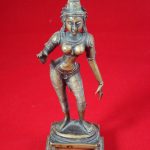
Then there was India – Bombay, Ahmedabad, Indore (where we got caught in the Festival of Colors, Delhi, Agra, Varanasi (one of the holy cities on the Gange with its burning Ghats, Khajuraho (with its erotic temple – convinced the Air India to make a special unscheduled landing to visit), Durgapur (our partner was part of the Marahaja’s family). We were shown the empty harem full of antique carpets which could not be moved because of the ghosts of the wifes were still occupying the place. There was also Hyderabad and Madras in the South.
India has a rich culture of arts including bronzes, sculptures, textiles, carved ivories and rare wood, ceramics..etc. Some of these items can be found on this site but were acquired in India, Ceylon or Indonesia as Indian civilization was spread through the region from the 7th to 13th century through Hinduism and Bhuddism.
Read more: https://en.wikipedia.org/wiki/Khajuraho_Group_of_Monuments
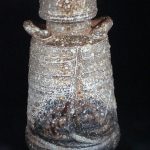
Moving from Hong Kong to Tokyo would influence the Wanderers for the rest of their lives both for cultural and business reasons. She concentrated on ceramics in Kanto, Kansai, Kyushu..etc. The cross influences with China and Korea on such ceramics as Shigaraki, Tamba, Bizen, Tokoname, Echizen, and Seto. A few pieces acquired in the 70’s are shown on this site.(https://en.wikipedia.org/wiki/Japanese_pottery_and_porcelain)
There was also the various designs of kilns (kama or gama) such as the noborigama and anagama which came from Korea in the 4th century (https://en.wikipedia.org/wiki/Talk:Anagama_kiln)
Shigaraki Vase
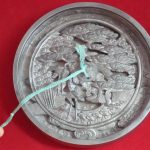
But there was some much more to see and learn – the textiles from all areas of Japan with their hand-dyed colors, the lacquersware (urushi), the baskets used for ikebana, the metalware (such as the Meiji mirror on left), the ukio-e (several on this site) and kakemono (hanging scrolls common in all of Asia), the samurai weapons which used the Toledo method to produce multi-layer steel swords which were strong and flexible.
Most important was the language and the Kanji writing system which would enter from China around 500 AD. At that time, Japan had no formal writing system and the arrival of Kanji characters required that two phonetic character systems (hiragana and katakana) be also created to permit adapting the Japanese language to a written form. The onyomi and kunyomi represent that adaptation (http://www.nilsjapan.com/fukuoka-times/learning-kanji-onyomi-and-kunyomi/).
In 1975, the Wanderer took a 1-year sabbatical to study Japanese at Kyoto University while she concentrated on Japanese ceramics.
Then as the Wanderers relocated to Singapore, a new and rich ground for Southeast Asian collectibles opened. The flow of culture from India in the West, China in the North and Japan in the East provided a cultural influence on the arts of Burma, Thailand, Laos, Vietnam, Malaya, Indonesia and the Philippines – countries which have their own, often tribal, independent arts.
The Wanderers traveled through the cities of Burma – Rangoon, Pagan and Mandalay. Stayed at the Strand Hotel built by John Darwood in 1901 and later acquired by the Sarkies brothers, who owned a number of luxury hotels in the Far East, including the Raffles Hotel in Singapore and the Eastern & Oriental Hotel in Penang, Malaysia. At the time of our stay, the hotel was empty although dinner required coat and tie. See for more details ( http://www.historichotelsthenandnow.com/strandyangon.html ).
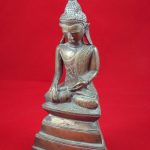
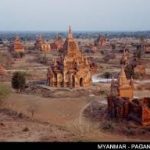
Bagan (formerly Pagan) is an ancient city located in the Mandalay Region of Myanmar. From the 9th to 13th centuries, the city was the capital of the Pagan Kingdom, the first kingdom that unified the regions that would later constitute modern Myanmar. During the kingdom’s height between the 11th and 13th centuries, over 10,000 Buddhist temples, pagodas and monasteries were constructed in the Bagan plains alone, of which the remains of over 2,200 temples and pagodas still survive to the present day. An earthquake in 1975 damaged many of the temples but this was after our visit.
For a week the Wanderers traveled around the temples by horse-drawn cart with a lady driver smoking the biggest cigars ever seen. There were no major hotels – the nights were under the roof of a farm house infested with noisy rats. From Pagan, the return was by boat on the Irrawady to Magwa accompanied by nervous Burmese soldiers. The following destination was Mandalay with its temples on top of hills. In those days, the Golden Triangle it was the center of production of opium and still occupied by the remnants of the Kuamingtang (KMT) cooperating with the Shan states which were mostly defeated in the Sixties by the Chinese and Burmese armies. Nevertheless, at the time of our visits, it was still risky to wander too far from Mandalay. For more info: https://en.wikipedia.org/wiki/Kuomintang_in_Burma
MORE TO FOLLOW SOON